 deutsch
The memorial chapel is flanked by two paintings by the Rostock artist Egon Tschirch. Both paintings depict different aspects of violence: brutality and suffering in the painting „Ecce homo“, and destruction and ruin in the painting „The Destroyed City“.
Egon Tschirch (born 22 June 1889 – died 5 February 1948), who trained at institutions including the Royal Art School and the Berlin University of the Arts, is regarded as one of the most significant painters of 20th-century northern Germany. He was exceptionally prolific, versatile and keen to experiment, and, despite his Mecklenburg motifs, was not a regional painter. The German Empire, the Weimar Republic, the Nazi era and the occupation – Egon Tschirch painted and sold his works throughout all these periods, with growing success.
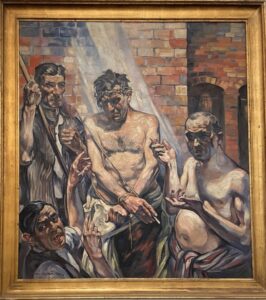
The painting ‘Ecce homo’ (1926, oil on canvas) depicts a scene from the Gospel of John (19:5). It depicts the moment when Pontius Pilate presents the tortured Jesus to the crowd and utters the famous words: ‘Behold, what a man!’, whilst the crowd demands his death. This motif was repeatedly taken up by artists, particularly in the 19th and 20th centuries, to illustrate the fate of humanity in a world threatened by violence and war.
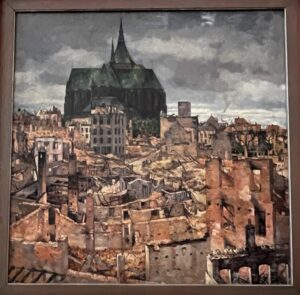
Painting ‘The Destroyed City’ (1942, oil on canvas): Immediately following the bombing raids on Rostock in April 1942, Egon Tschirch noted in his diary on 20 May: ‘Painting ruins at the corner of Grubenstraße and Krämerstraße’, and completed the large-scale painting a month later. Tschirch produced many cityscapes of Rostock, but the painting ‘The Destroyed City’, featuring the intact St Mary’s Church, was to be his last depiction of his hometown.
Both paintings invite us to remember, but also to reflect, as they depict not only human vulnerability but also human responsibility.