deutsch
Dear Visitors,
You are standing in a particularly significant part of St Mary’s Church!
This chapel, which has a history of its own, has been a place of remembrance and commemoration for the victims of the two world wars since the 20th century.
The nature of such remembrance is subject to social change. The parisch is seeking a meaningful way to engage with this legacy.
This information terminal aims to convey the historical background to this site. It also aims to serve as a stepping stone on the path towards a dignified approach to the themes of war, suffering and reconciliation.
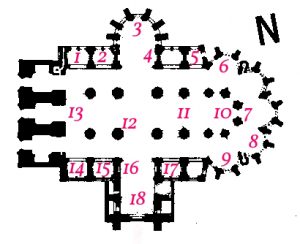
This chapel (No. 9 on the plan) is one of the side chapels incorporated into the structure of St Mary’s Church.
Owing to its prominent position in the ambulatory, it was used by the town council during the Middle Ages. The council had Masses said here for the salvation of the souls of both deceased and living councillors, and also held its meetings here. The original furnishings, including the side altar, pews and chapel screen, have not survived. Only the bricked-up door in the western outer wall still bears witness to its use by the councillors. They had exclusive access to their chapel.
With the Reformation, the chapel lost its function. Joint worship became the centre of parish life. From the 18th century onwards, the councillors took their seats in the pews beneath the princely gallery.
At the end of the 19th century, the space was enhanced with stained-glass windows. The depiction of the Ascension of the risen Jesus Christ may have been the inspiration for creating a memorial chapel her specifically after the First World War.
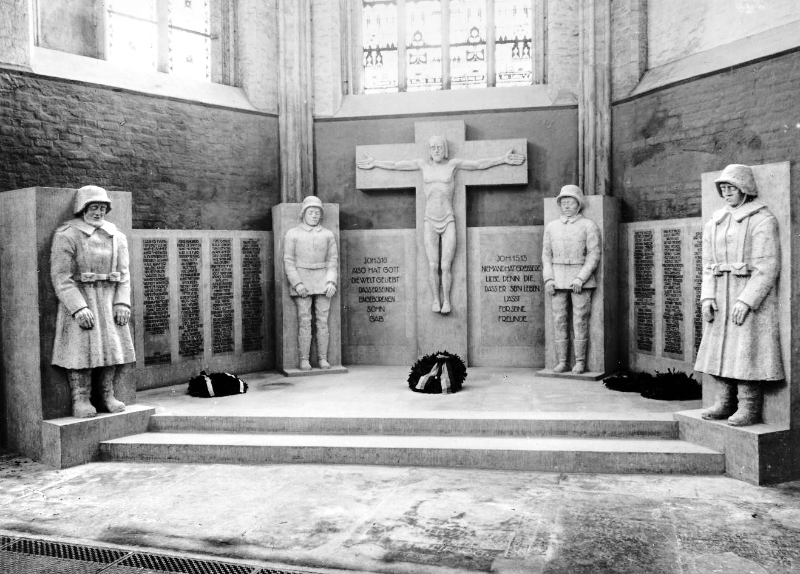
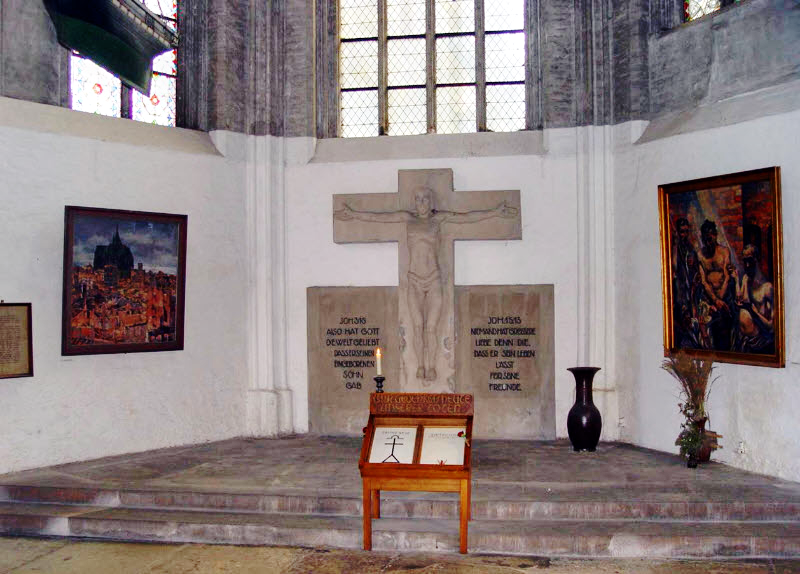
The former town hall chapel was converted into a memorial site in 1923. Of this complex, only the figure of Christ on the Cross remains.
The original monument was the work of Walter Rammelt (1890–1947), whose Expressionist design won a competition in 1922. After the war, deeply scarred by his war injuries, Rammelt settled in Rostock as an artist.
Surrounding the figure of Christ on the Cross were eight plaques set into the walls bearing the names of over 200 members of the congregation who had died as soldiers, and four upright gravestones featuring larger-than-life figures of fallen soldiers. The chapel became a place of mourning.
A few years later, such an unheroic commemoration was deemed incompatible with the aims of National Socialism. The monument was denounced as ‚degenerate art‘. The focus of the criticism was on the dead warriors: ‚Sad, wretched figures are affixed to the pillars, which are a mockery of the brave heroes who fell in the sacred struggle for the most sacred causes‘, stateda letter to Senior Pastor Schoof in 1937. In 1940, the complex – with the exception of the crucifix and the plaques bearing the two biblical verses – was demolished.